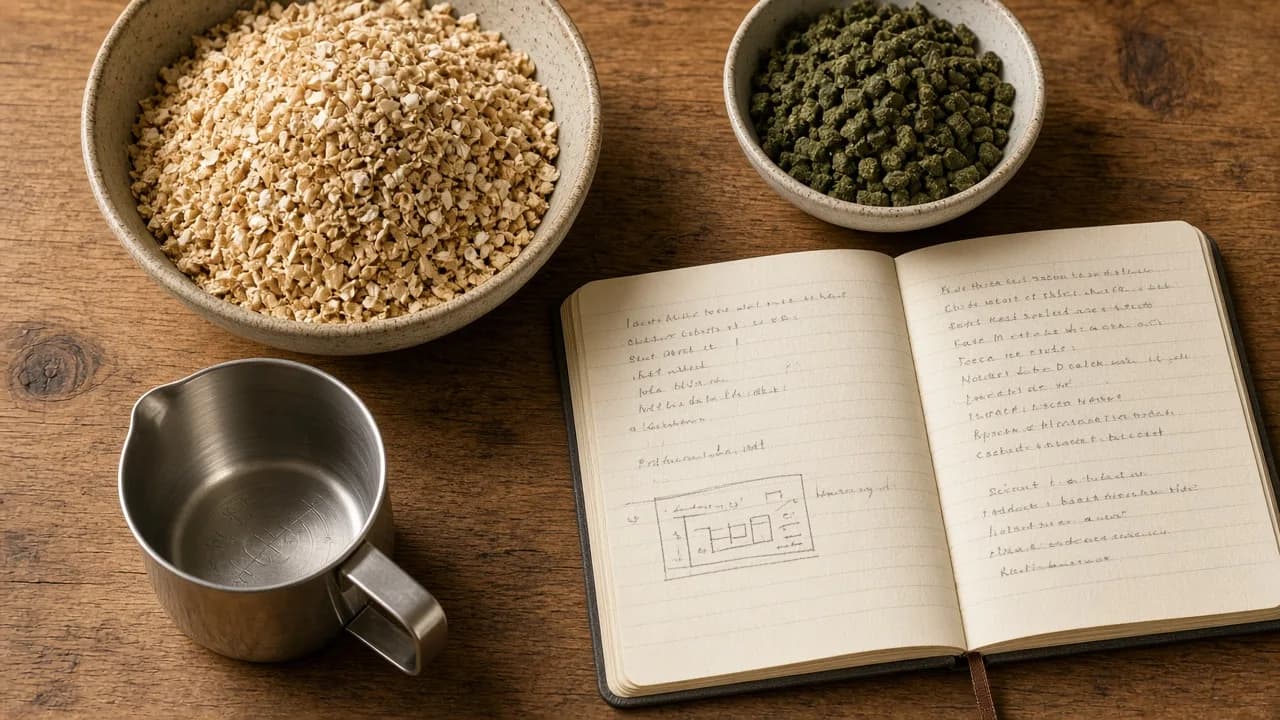
A home-brew recipe is a specification. It says how much wort you intend to collect, what original gravity you are aiming at, which fermentables get you there, which hops add bitterness and aroma, and which yeast should ferment it. The BJCP 2021 guidelines give you target ranges for those numbers. Your notes after brew day tell you whether the process matched the page.
This is not a store of recipe packs. Archive URLs that once sold “23 litre BIAB” bags now 301 here so the method survives and the catalogue does not.
Three ways to make the same pale ale
Kit. A hopped malt extract tin plus a yeast satchel. The recipe is mostly the manufacturer’s. Your variables are volume, temperature and sanitation. Useful for learning gravity. Limited once you want a different hop.
Extract. Unhopped liquid or dry malt extract, steeped specialty grain if you want, hop additions you time yourself, and a yeast you choose. You can hit pale-ale or stout colour without a mash tun.
All-grain. Crushed malt plus water held at a conversion temperature, then a boil. The all-grain method page is the process essay. Brew-in-a-bag and three-vessel systems are both all-grain; they differ in how you separate wort from grain, not in the underlying enzymic idea.
Pick the method that matches the equipment you already trust.
Write the header first
Before a grain bill, write:
- Batch volume in the fermenter (for example a typical household 19–23 litre batch — use the volume you can actually cool and lift).
- Target original gravity, taken from the BJCP range for the style.
- Target bitterness, also from that range.
- Yeast strain and its published fermentation band.
- Water: tap, filtered, or a simple adjustment you can name.
If you cannot fill in those lines, you do not have a recipe yet. You have a shopping impulse.
Grist
Base malt or base extract does most of the work. Pale ale malt, pilsner malt or traditional ale malt are the usual bases; pale extract stands in for them in extract recipes. Specialty malts change colour and flavour in small percentages: crystal or caramel for toffee and body, Munich for bread-crust, wheat for foam and haze, roast for stout.
The heritage essay on malted grains explains those roles without republishing a maltster’s entire PDF. When you use a named maltster, treat their current specification sheet as the source, not a memory of an old shop page.
Adjuncts — flaked oats, maize, rice, lactose in a sweet stout — are optional and style-specific. They are not a requirement for “craft.”
Hops
Bitterness mostly comes from early boil additions. Flavour and aroma come from later additions and from dry hops after fermentation. The alpha acid on the packet determines how much hop you need for a bitterness target; that number changes by lot. Software can help you estimate. This site will not invent an IBU figure for a hop that is not in front of you.
Australian and New Zealand hop varieties are widely used in pale ale and IPA. Classic European hops still suit pilsner and bitter. Freshness and cold storage matter more than a story about a harvest festival this page will not invent.
Yeast and fermentation as part of the recipe
Write the yeast into the recipe, including the temperature you will actually hold. A Kölsch-style ale fermented too warm is not the beer you specified. A wheat beer fermented dead cold may never show the character the guidelines describe.
Pitch enough yeast. Underpitching a strong beer is how ferments stall. The yeast essay covers oxygen at the start and a calm finish.
Water, briefly
If your tap water makes good tea, it will make a first pale ale. Once you care, you can read a local water report and adjust sulfate and chloride in small, measured additions. Do not add random “beer improver” blends as a substitute for knowing whether you wanted a drier or rounder hop impression.
A worked method, not a branded clone
Suppose you want an Australian sparkling ale in the pale, dry family.
- Choose a modest original gravity inside a pale-ale range from the BJCP.
- Use pale malt or pale extract as almost the entire grist.
- Add at most a light crystal malt if you want a gold rather than straw colour.
- Hop for moderate bitterness with a late addition for aroma, not a double-IPA dump.
- Pick an ale yeast known for a dry finish and hold it in its published band.
- Ferment to a stable gravity, then bulk prime or keg.
That is a recipe. It does not require a trademarked commercial beer name, a fake laboratory analysis, or a price.
A stout swaps in roast barley or dark malt at a small percentage and may use a different hop, often lower aroma. A wheat beer swaps a large fraction of the grist to wheat and, more importantly, swaps the yeast. An IPA raises hop mass and often original gravity. Change one lever at a time so you can taste what you did.
Record what happened
On brew day write mash temperature (if any), boil length, hop times, original gravity, pitch temperature, and the daily or every-few-days gravity until it holds. After packaging, write the date you first tasted it. Those notes are how a recipe becomes yours. They are also how you stop repeating a mistake.
Legal and health lines that belong on a recipe page
Do not add distilled spirit to a beer to “make it stronger.” Mixing distilled alcohol is a different tax and licensing problem; see the ATO spirits page and our legal guide. Do not publish a recipe that teaches distillation.
Beer you recipe-build is still alcohol. The NHMRC 2020 guidelines apply to the bottles you will line up on the bench: no more than 10 standard drinks a week and no more than 4 on any one day for healthy adults.
If you arrived from an old or “clone” URL, stay and write a method of your own. The archive catalogue is gone. The craft is not.
Scaling without folklore
If you change volume, change every fermentable and hop addition in proportion, then check that your kettle can still boil what you collected. Efficiency — how much sugar you actually got from the grain — is measured, not wished. A smaller batch on a new system will not hit last month’s number until you record it.
When you scale a keg recipe down to a starter-size test, you are still making alcohol. Tiny batches are a good way to try a hop. They are not exempt from sanitation.
Hops in the freezer
Label the year and the alpha acid from the pack. Use older hops earlier in the boil if you use them at all. Aroma hops want to be the freshest ones you have. This is ordinary oil chemistry, not a harvest-festival claim.
Do not dry-hop a beer so aggressively that you introduce oxygen with a week of sloshing. Close the vessel. Give it a few days. Then package.
When a recipe fails
Write what failed: gravity too low, roast too loud, yeast too warm, infection, flat bottles. Change one thing. A failed batch is data if you keep it, and a myth if you do not.
If the beer is merely young, wait. If it is infected in a way you do not want, discard it. This site will not invent a percentage of batches that “should” fail.
Sharing recipes
Publish a recipe as a specification: volume, gravities, malts with percentages, hops with times, yeast with temperature. That is citeable. A social post that says “a bit of pale and some galaxy” is not a recipe.
Do not republish a commercial brewery’s unpublished production sheet. Do not invent one.
The BJCP 2021 guidelines remain the shared language when you hand the sheet to someone else.
If you only write one recipe this year, write a modest pale ale with a named yeast and a hop you can buy fresh. Repeat it until the gravity is boring. Then change one lever. That is recipe work. Everything else is shopping, and this site does not shop.